Saturday, February 28, 2015

Trading for Cole Hamels

This post was in the works prior to the Tuesday's news that Adam Wainwright would be returning to St. Louis due to abdominal soreness. The Cardinals expect to receive the results of the examination later this week. I'm in favor of trading for Hamels even if Wainwright is completely healthy, but if Wainwright is hurt and will miss a significant amount of time, the importance of making a trade increases.

The Cardinals should seriously consider trading for Philadelphia’s Cole Hamels, even if it means including Carlos Martinez. The Cubs and Pirates are young teams that will improve each year. The Cubs in particular seemed poised to utilize their outstanding farm system and massive financial resources to get better in a hurry. On the flip side, the Cardinals core of Matt Holliday, Jhonny Peralta, and Yadier Molina will be a combined 100 years old this year, Jason Heyward is a free agent at the end of the season, and, outside of Stephen Piscotty, there is scant offensive talent on the horizon in the farm system. 

If all of the Cardinals starters are healthy, they have one of the best rotations in the league. However, there are significant questions surrounding the health of their top two projected starters, Adam Wainwright and Michael Wacha, and the depth beyond Marco Gonzales is thin. Additionally, John Lackey will be 36 and posted a 4.27 FIP and 4.30 ERA in his ten starts with the team in 2014. Baseball Prospectus' PECOTA projects him to be just above replacement level. This is fine for a fourth or fifth starter, but an injury to the top of the rotation pushes Lackey into the third starter role and he is not suited for it. 

What would a trade for Hamels look like? It has been reported that the Phillies have stated that any trade with the Cards will start with Carlos Martinez. I’d be ok with that. As detailed in my fifth starter post, Martinez oozes with upside, but he has some work to do to convert the raw talent into MLB production. While the Cards can afford to give him a chance to do this as a fifth starter, asking much more from him is a stretch. The issues he faces in his development are significant and I think it's highly likely that he becomes a valuable relief pitcher rather than a starter. 

The Cards top three prospects are Gonzales, outfielder Stephen Piscotty, and young right-handed pitcher Alex Reyes and they are all among the top 100 prospects in baseball. If the Cards are including Martinez, it’s unlikely that they would also include any of those players unless Philadelphia agreed to pay a significant portion of Hamels’ future salaries. Despite making his MLB debut last summer and contributing through the playoffs, Randal Grichuk is still eligible for inclusion on the prospect lists and ranked as high as fourth on Baseball America's. That's decidedly too high and he should be ranked somewhere in the 8-15 range. All of the scouting reports acknowledge he has above average power and is an excellent athlete capable of playing all three outfield positions. They also acknowledge that his approach needs to be refined. Even without an improved approach, his positives outweigh the negatives and he could provide at least average value in MLB this year. I touched more on Grichuk in my post on the bench. He is only 23 years old and would be an obvious second piece to any deal. It's possible the Phillies would prefer Peter Bourjos to Grichuk. While I like Bourjos' chances of bouncing back from his awful 2014 season, I think he and Grichuk have about the same trade value. I'd rather give up Grichuk, but would not hesitate to make a deal if the only difference was giving up Bourjos instead of Grichuk.

The third, and possible fourth pieces, will take the most work to agree on. If the trade includes Martinez and Grichuk, the Phillies will have already received two players capable of contributing to this year’s team, so they will likely seek one or two high-upside players. I have to think young outfielder Magneuris Sierra would be at the top of the Phillies’ list. 

Sierra was the Cards’ minor league player of the year last season after hitting .386/.434/.505 in the Gulf Coast League as an 18 year old. He made the back halves of Keith Law and Baseball America’s organizational top 10 prospects and garnered a 'Prospect on the Rise' mention from Baseball Prospectus. He is a no doubt future center fielder with good speed and outstanding bat control, leading some to project a plus bat. He has a small frame and only had 17 XBHs in his 223 PAs, so he does not project to ever hit for much power. He just completed his first season in the United States and played in the Gulf Coast League. He's very far away and his highly conservative rankings reflect this. In order to improve his value, he'll need to show that he can play at a high level in a full season league. He may get the chance to do this in 2015, but the Cards could hold him in Extended Spring Training until the New York-Penn League starts in the summer. As enticing as Sierra's upside is, it's more likely that he flames out in full season ball and this is the peak of his value. Trading him could come back to bite the Cards, but he is exactly the type of player the Phillies should be seeking to round out a Hamels trade. 

A package of Carlos Martinez, Randal Grichuk, and Magneuris Sierra should be enough to pry Hamels from the Phillies. The Cards have the financial resources to absorb the remaining money due on his contract and adding him to a rotation maximizes the team’s chances of winning before its window closes. Swapping Martinez for Hamels greatly improves the 2015 and 2016 rotations without hurting the team much beyond that. While there’s a chance that Grichuk develops into an everyday centerfielder, there remain significant questions regarding his aggressive approach and struggles against same-side pitching. Those could prevent him from reaching his ceiling. Finally, Sierra offers the highest upside of any prospect outside of the Cards’ top three prospects. None of their top prospects should be included in a trade unless the Phillies eat some of Hamels’ money. Sierra is a long way away and while he could develop quickly, it’s unlikely he’ll be contributing at the major league level until 2018 at the earliest. He’s exactly the type of player the Phillies should look to acquire a third piece in any Hamels trade as he’s not a top prospect, but if he’s able to repeat his GCL performance in a full season league, will see his prospect stock ascend.

This is really about the Cardinals current team composition, the competitive landscape, and their resources. They are an aging team with a shallow rotation. Adding a Cy-Young caliber arm, capable of making 30 starts a year, would do wonders to any team, but would bring stability to a rotation with a lot of questions. The Cards division is improving quickly and the Cards should seek to maximize their chances of winning while the younger teams are still improving. Finally, the Cardinals have stated they have significant financial flexibility. It's clear they will be major players in next year's free agent market and getting Hamels now somewhat limits the downside risk associated with free agents because he is only under contract for four years. Any pitcher signed in next year's free agency will likely require six or more years, so Hamels is a significantly less risky asset than would be available on the open market. 

Thursday, February 26, 2015

Spring Training Preview, Question 6: Jason Heyward

In a series of seven posts, I'll be looking at some early spring issues facing the Cardinals. Today's question covers right-fielder Jason Heyward, the team's key offseason acquisition.

The biggest move of the Cardinals offseason was acquiring right-fielder Jason Heyward and relief pitcher Jordan Walden from the Braves in exchange for pitchers Shelby Miller and Tyrell Jenkins. Miller has made 31 starts in his first two MLB seasons, accumulating 2.4 fWAR and a career 3.33 ERA. He finished third in the 2013 NL Rookie of the Year award and turned his 2014 season around in the second half. Still, significant questions remain about his ultimate ceiling. He has four seasons of control remaining. Jenkins is the ultimate lottery ticket and has battled numerous arm problems since being drafted out of high school in 2010. He was healthy in the Arizona Fall League, showed his best stuff in years, and vaulted into Keith Law's top 100 prospects. Heyward is a free agent at the end of the season and will only be 26 when he hits the market. The Cardinals are all but guaranteed to make a qualifying offer to him and receive a first round pick if he signs elsewhere, which seems likely since he'll likely command $180-200 million over a ten year contract. Since debuting with a Grand Slam for his hometown team, Heyward has faced exceedingly high expectations. He's a very smart ballplayer and constantly looks for ways to add value and help his team win. He has consistently rated as one of the best defensive rightfielders in the game and has two Gold Gloves to show for it.

The questions about Heyward center around his offensive game, particularly his power. After debuting with a .456 slugging percentage and 52 extra base hits, he struggled to a .384 SLG in his second season. In that second season, he surged out of the gates and hit .263/.354/.525 in April. He struggled to a .098/.229/.122 May before hitting the DL with a strained shoulder. He returned in the middle of June and only hit .234/.321/.379 the rest of season as the Braves collapsed and ultimately missed the playoffs. He bounced back from the down 2011 to hit 27 home runs and slug .479 in 2012 and slugged .427 in another injury shortened 2013.

He had the lowest slugging percentage of his career in 2014 at .384 and his isolated power of .113 was in between Jose Reyes and Denard Span. What happened? According to Heyward he was asked to bat leadoff 94 times in 2014, something he had only done 31 times in the proceeding four seasons, and he drastically changed his approach to emphasize getting on base. Is there something to this? In 2014, Heyward swung at the first pitch in 67, 10.3%, of his 649 PAs. In the first four years of his career, he swung at the first pitch in 184, 8.5%, of his 2,170 PAs. Prior to 2014 he had also done a lot more damage on first pitches, hitting .373/.386/.638. In 2014, he only hit .299/.299/.358 on first pitches. One would expect a leadoff hitter to be more patient and Heyward did see 3.93 pitches per plate appearance in 2014. That was good for 51st among all qualified hitters, but was tied for the lowest of his career. He has been over four pitches per plate appearance in each year of his career with the exception of 2011 and 2014.

Like Matt Adams, Heyward also saw his a large drop in his average fly ball distance. Heyward's fell almost 20 feet from 2013 to 2014 - even more than Adams'. Due to this drop Heyward had terrible performance on his fly balls last year, hitting .180 with a .119 BABIP. Removing his 11 HRs, he hit 159 fly balls and only 19 of them fell in for hits. Regardless of how far a fly ball is being hit, that's incredibly bad luck and should change in 2015.

Heyward also uncharacteristically struggled hitting to the opposite field. In 2014 he hit .274 and slugged .347 with just five extra base hits on batted balls to left field. For the rest of his career he has hit .344 and slugged .515 when he hits the ball to left field. His batted ball profile for balls hit to the opposite field was not substantially different than the rest of his career:


LD
GB
FB
IFFB
2014
20.8%
20%
59.2%
13.5%
Career#
20.2%
19.6%
59.9%
22.5%
#Some rounding error exists on the career numbers

Again, it's clear that Heyward got extremely unlucky on his performance to balls hit to the opposite field in 2014. This was compounded by the fact that he was hitting more of them:


LF
CF
RF
2014
26.2%
33.7%
40.2%
Career
19%
30.4%
50.5%

This is the NUMBER ONE area Heyward must improve on in 2014. It's nice to hit the ball to the opposite field, especially when it's pitched away, but hitters do their damage hitting the ball to their pull side. He must resume pulling the ball more frequently and stop trying to go to the opposite field. This is the one area it makes sense that he altered his approach as a leadoff hitter. Leadoff hitters would try to make contact and get on base, even if it means sacrificing pull side power to dink hits the opposite field. Heyward, however, must pull the baseball because he has more power potential than most players in the game. He's a career .309 hitter with a .508 slugging to RF and 20.2% of his fly balls to RF have left the yard. 

The other question about Heyward's offensive ability is his performance against left-handed pitching. It was downright atrocious in 2014 and some fans and media are wondering if the Cards would be better off platooning him in RF with a right-handed hitter like Randal Grichuk, who thrives against left-handed pitching. Heyward was hit in the face by Jon Niese on August 21st, 2013. He returned to play nine games in late September and started each of the Braves' division series games against the Dodgers. Coming into 2014, he had hit .232/.312/.377 in his career vs left-handed pitching and in 2014 he cratered to .169/.252/.225 in 159 PAs.

There is some thought that the HBP in August, 2013 affected his approach, but the numbers suggest his production against lefties in 2014 was merely a product of bad luck. His K/BB ratio against left-handed pitchers was 0.38 for 2010-2013 and 0.34 for 2014, nearly equivalent. The biggest difference was his BABIP which was 0.287 in 2010-2013 and 0.208 in 2014. He did hit slightly more groundballs, at the expense of line drives, against left-handed pitchers in 2014 than his career average, but not enough to impact his BABIP by 79 points. I'd expect for his performance against left-handed pitching to bounce back in 2015.

I'm excited to see what Heyward can do this year. The team stated that he will not be asked to lead off and he's indicated that he could tap into more power by utilizing a different approach by hitting further down in the lineup. While I do not completely buy into that, I do think he'll show much better power than he did in 2014. Turner Field and Busch Stadium are about equally average places for left-handed batters to hit, so there will not be a large adjustment to his numbers from that perspective. Any question of platooning him should be forgotton: Heyward is an everyday player. According to Baseball Prospectus, he's been on the DL four times in his career and missed a total of 82 games. Two of those stints were for appendicitis and the previously mentioned HBP - fluke injuries. He has not been on the DL with another, less random injury since May 2011 when he hurt his shoulder. Removing the flukish DL stints, Heyward has played in 93.5% of his team's games. His defensive value alone makes it imperative for Matheny to get him in the lineup everyday, and if he hits the way he's capable off, he's a surefire MVP candidate. Hopefully Heyward is able to answer the questions surrounding his offensive ability and change the conversation to questions about his pending free agency.


Wednesday, February 25, 2015

Spring Training Preview, Question 5: The Bench

In a series of seven posts, I'll be looking at some early spring issues facing the Cardinals. Today's question covers the bench.

The Cardinals bench received the biggest make-over of any aspect of the team this offseason. Since the start of the 2012 season, Cardinals pinch hitters have combined to hit .206/.290/.291 in 767 PAs. That’s the fourth lowest batting average and on-base percentage and the lowest slugging percentage of National League pinch hitters over that span. The bench was one area of the team the Cards desperately sought to improve this offseason – particularly in the power department.

The make-over began by bidding adieu to long-time bench stalwarts Shane Robinson and Daniel Descalso. Robinson and Descalso were the only two members of the bench to receive at least 100 PAs as pinch-hitters from 2012-2014. The next most used option, over that span, was current starting first baseman Matt Adams with 51 PAs. Beyond Robinson, Descalsco, and backup catcher Tony Cruz, the bench was a constantly changing group. Over the years, the team attempted to improve the bench with free agent signings like Ty Wigginton and Mark Ellis, but both were disasters. Ellis was signed last off-season and the move was widely praised, but he got injured in spring training and never got into any sort of rhythm. He departed St. Louis after a disappointing .180/.253/.213 season and has yet to find a new employer. Wigginton has also yet to find another employer since being released in 2013, despite being guaranteed his contract in 2014.

The first name who will enter into the mix this year is Mark Reynolds. Reynolds was signed this offseason to a one-year, $2 million contract and the Cards hope that he’s more successful than the previous free agent signings mentioned above. The Cards will be Reynolds’ fifth team in four seasons. He’s changed teams each offseason since 2012 and was released in the middle of 2013 by Cleveland, but promptly caught on with the Yankees. Reynolds’ game is well known at this point. He led the league in strikeouts in four consecutive seasons from 2008-2011, but he also hit 141 home runs over that span. While he has not hit more than 23 home runs since then, he’s also seen his playing time decrease. All told has averaged a home run every 19.9 PA in his career but has also struck out in nearly 32% of his PAs. His average fly ball distance has increased in each of the past two seasons to 299.24 feet in 2014 – good for 17th in baseball. He’ll bring a welcome injection of power to the bench.

I’ll be surprised if Reynolds exceeds 400 PAs in 2015 since the Cards have Matt Carpenter and Matt Adams in front of him, but he could see ample playing time at first if Adams continues to struggle against left-handed pitching. Although Reynolds hit right-handed pitching better than left-handed pitching in 2014, he hasn't traditionally had much of a platoon split, much less a reverse platoon split. Although his career OPS vs left-handed pitching is 39 points higher than his OPS vs right-handed pitching, the difference is entirely due to a much better BB/K ratio. His batted ball profile is similar but he's hit a bit more fly balls vs right-handed pitching at 47.3% compared to 44.6% vs left-handed pitching. His most important contribution, power, is almost identical vs either as he's slugged .457 with a 20% HR/FB rate vs right-handed pitching and .458 with a 19.5% HR/FB rate vs left-handed pitching.

If Carpenter is injured for an extended period of time, it’s unlikely that Reynolds would become the everyday third baseman. His career defensive runs saved at 3B is -56 and he last played third more than first in 2011. Since transitioning to 1B, he's improved his defense in each season and has gone from negative UZRs in 2011 and 2012 to just barely positive in 2013 to decidedly positive last season. He’s an outstanding use of a roster spot and a bargain at $2 million. While some fans will be frustrated with his strikeouts, he remains a threat to hit a home run every time he comes to the plate.

Randal Grichuk is most known for being the player drafted before Mike Trout in the 2009 draft. That fact requires an asterisk since the Angels had consecutive picks so they were going to get Trout regardless. After a promising 2009 debut in the Arizona League, Grichuk progressed slowly and was limited by his aggressive approach at the plate. He topped out at the Angels AA affiliate before being traded to the Cardinals last offseason. He opened 2014 in AAA Memphis and after 21 games found himself in the major leagues. He would shuttle between Memphis and St. Louis the rest of the season, but established himself as a key role player down the stretch and played every game in the playoffs.

Grichuk's 36 postseason PAs best exemplified his skills and weaknesses as a player. He struck out 13 times and only hit .171, but two of his six hits were home runs. This was similar to his regular season MLB line of 116 PAs with a 31/5 K/BB ratio and ten of his 27 hits went for extra bases. It will be interesting to see what the Cards do with Grichuk in 2015. He’s still only 23 years old and amazingly only took ten PAs against pitchers younger than him in 2014. Although he can play every OF position, he's best suited for a corner. While he can provide value at the MLB level due to his defensive ability and power, he has a number of flaws that could be addressed in AAA.

Grichuk has a wide platoon split and if he's on the MLB roster, he could only be used against left-handed pitchers. Last season he hit .297/.337/.627 against left-handed pitching compared to .235/.289/.396 vs right-handed pitching. He also has never drawn more than 28 walks in a minor league season and has a career 479/112 K/BB ratio. While it's unlikely he's going to make significant progress in that department, he needs to show some improvement to be a part time contributor at the MLB level. One easy change he could make to his approach is to start swinging MORE. Grichuk has only swung at 16% of pitches outside of the strike zone in 2013 and 2014 in the minor leagues. In MLB last year, Matt Carpenter was the least likely to swing at a pitch outside of the zone and even he did so 19.3% of the time! Grichuk was slightly more aggressive in 2014 at Memphis, swinging at 19.3% of those pitches and the rate ballooned up to 32.1% in his brief time in MLB. His MLB rate is a bit too aggressive and would have comfortably put him in the top of qualified hitters, but he should look to be somewhere in the low 20s. The average qualified MLB hitter swinging at more than 32.1% of pitches outside of the strike zone made contact 68.45% of the time. Grichuk only did so 38.8% of the time between Memphis and MLB last year. Grichuk cannot be one of the most aggressive hitters in the league because he lacks the bat to ball skills of those hitters. He can, however, be more aggressive than most because he has excellent bat speed and can drive any ball he contacts.

Despite being athletic and capable of playing CF, Grichuk is not an exceptional baserunner and has only been successful on 33 of his 50 attempts in his minor league career and is 0/2 in MLB. Grichuk does play well into his strengths and he needs to translate that skill to the MLB level. In his 2013 and 2014 minor league seasons, he only hit ground balls at 35.8% clip. That would have been among the 15 lowest of qualified hitters in the MLB. Since he does not hit the ball on the ground much, he's able to tap into his power.

There is no doubt Grichuk has an exciting profile and potentially a bright future. His home run against Kershaw in last year's playoffs set the tone of the series and he was without a doubt the best option in RF vs LHP down the stretch. He is always going to have some swing and miss in this game, but that's acceptable since he has the potential to hit 20-25 home runs. He needs to improve vs right-handed pitching and try to refine his approach. The best place for him to reside to start the season is back at AAA. Regardless of where he starts the season, I imagine he'll spend significant time in the big leagues in 2015.


If Grichuk opens the year at AAA, look for Tommy Pham to make the team as the fifth outfielder. Like Grichuk, Pham is capable of playing every position, but he is a very good defensive centerfielder. The knock on Pham is that he has struggled to stay on the field. The 2014 season was the first time that he played in more than 100 games since 2010. He only played 52 games in 2011 and 2012 combined and lost a lot of development time along the way. His injuries over that time included a broken wrist and a shoulder injury sustained from diving into a base. His prospect stock was so low that he was passed over in the 2011-2013 Rule 5 drafts. He was finally added to the 40-Man roster last September after hitting .324/.395/.491 in a full AAA season. That's a significantly higher OBP and OPS than Grichuk. Pham is also a tick faster than Grichuk and went 20/22 on the bases last year and is 113/148 in his career. Due to that speed, Pham has always had a high BABIP so last year's .397 BABIP is not an immediate red flag since his career BABIP is .374. Pham receives a better PECOTA projection than Grichuk due in large part to his superior defensive ability and on-base skills. At this point he is a more polished and consistent player, but in the long run, Grichuk has more upside. Pham will be 27 at the start of the season and does not have much, if anything, left to prove in the minors. If he's healthy, he should be contributing at the MLB level. He's a prototypical fourth outfielder. Look for him to start the season in MLB with Grichuk going to Memphis.

The utility infielder bench spot is the most open position player competition in camp. The favorites are considered to be Pete Kozma and Dean Anna. While Ty Kelly, Greg Garcia, and Jacob Wilson will all get a look, they are all expected to start the season in Memphis.

Kozma, of course, was famously pressed into duty late in the 2012 season when starting shortstop Rafael Furcal went down with an injury. He managed to hit .333/.383/.569 in 26 games and was one of the heroes of the miraculous Game 5 comeback against the Nationals. When Furcal went down again with an injury in Spring Training of 2013, Kozma was the team’s unquestioned starter based on a strong .359/.406/.578 Spring Training. He only contributed a .217/.275/.273 regular season line and went one for 25 in the 2013 NLCS and World Series. The Cardinals knew they had to improve at SS and signed Jhonny Peralta to a four year contract last offseason.

Kozma has a decent glove, and while I would hesitate to call him a plus defender, he’s an above average shortstop and second baseman. His .248/.330/.372 line in AAA last year represented personal offensive progress, but was still below average for his age and even position. He's one of the weakest hitters in the league and although his defense is good, it does not go nearly far enough to make up for his bat. His overall MLB career line of .236/.297/.320 is overly inflated by eight intentional walks in 2013, which was good for ninth in the in the league. It’s laughable that opposing managers opted to pitch around Kozma even once, let alone eight times. He was called upon in the playoffs last year since Kolten Wong struggled vs left-handed pitchers, but that was more about Wong's struggles than Kozma's added value. His minor league platoon split was about equal, so he's equally bad against left-handed and right-handed pitching. There's really no reason that Kozma should be on the team. He's trying to add value any way he can, going so far as volunteering to become the third, emergency catcher, but he's a below replacement level player regardless of how many positions he's able to play.


Dean Anna was signed to a major league contract this offseason after being released by the Pirates. This level of commitment makes it clear that the Cards expect him to contribute at the MLB level. Anna came up through the Padres' system before being traded to the Yankees and eventually claimed off waivers by the Pirates in 2014. He's a career .278/.379/.415 minor league hitter, including .296/.385/.432 in 823 AAA PAs. He is primarily a second baseman, but can play shortstop as well. He should absolutely be on the team over Kozma. He should also never face a left-handed pitcher as he only hit .127/.214/.175 against them in 2014. Anna only struck out 25 times in AAA last season and walked 33 times. In his minor league career he's walked 314 times and struck out 326. He struggled in a brief 25 PA showing in MLB last year, but he should be given another chance this year. Anna will take a solid at-bat - something Kozma struggles to do. Kozma does offer a split defensive upgrade to Anna, but Anna's bat more than makes up for that.

Ty Kelly is my favorite of the group and was acquired from the Mariners for pitcher Sam Gaviglio earlier this offseason. He’ll turn 27 in July and has yet to make his MLB debut, so the clock is ticking. Last year, he hit .263/.381/.412 in the Pacific Coast League with 15 home runs. The 15 home runs were a career high and represent nearly 40% of his career 39 home runs. He’s a switch-hitter and hit for noticeably less power from the right-side of the plate, but was still able to get on base at a .369 clip. Like Anna, Kelly takes good at-bats. In his minor league career, he has actually walked more times than he has struck out with 434 walks and 431 strike outs. Unlike Anna, he cannot play shortstop but he can play a little corner outfield and third base. It's clear the Cardinals had a prototype infielder they wanted to acquire this offseason - versatile defensively with solid on-base skills. Kelly and Anna both fit that to a tee.

Greg Garcia is the least likely of the group to make the team. He made his MLB debut and had a brief cameo last season but only went 2/14 with six strikeouts in 18 PA. His .333 OBP was boosted by an astounding three HBP. He has similar skills to Anna and Kelly, but is not quite on their level. In 2014 he struck out 95 times in 441 AAA PAs while he walked 41 times. He only slugged .382, and while he appeared in 13 games at SS, he made eight errors and should only be considered a second baseman. He appears to be an org player at this point, but he could find his way into 50-100 PAs a year in MLB if everything breaks correctly.

Jacob Wilson faces similar long odds, but is a better hitter than Garcia. He'll look to open the year at AAA and make up for lost time due to a knee injury last summer. He's one of my favorite prospects and is a career .268/.345/.437 hitter although he hit .302/.362/.460 in 283 PAs between the Florida State League and Springfield last seasons. If the power continues to play, he'll force his way to the MLB this summer, but I think it's more likely he debuts in 2016.

Aledmys Diaz is another name to watch. He’ll undoubtedly open the season at Memphis, but should contribute to the MLB team in some way this season. After defecting from Cuba, Diaz was signed to a four year MLB contract last spring. He had not played organized baseball in two years and struggled to get in shape and maintain his health over the long professional season. He’s been in the organization for a year and had the chance to build strength. When he was healthy in 2014, he hit .291/.311/.453 in 125 AA Springfield plate appearances. His defense at shortstop is passable and he can also play second and possibly third. John Mabry, the team’s hitting coach, recently said Diaz was a player to watch this spring and Baseball Prospectus reported that the industry as a whole thought he could really take off this year but are interested to see him perform over a full season before backing him too aggressively.

There is one other player whose role on bench is guaranteed. Tony Cruz has served as the backup catcher since he was called up in May 2011. He received a career high 150 PAs in 2014 due largely to Yadier Molina’s thumb injury. He was arbitration eligible for the first time this offseason and the two sides reached an agreement for him to receive a salary of $775,000 this season. Cruz brings next to nothing to the table. As Yadi’s understudy, he receives a fair amount of praise for his handling of pitchers, but that’s not quantifiable. He’s a defensive liability as opposing baserunners are 50/72 against him in his career, including 18/24 in 2014. He has also allowed ten passed balls and 35 wild pitches in his career with four and 12 of those, respectively, coming in 2014. His rate of passed balls per inning caught was the 11th highest of any catcher with at least 300 innings in 2014. At the plate, he’s a career .225/.271/.310 hitter with only three career home runs and he's trending downward. Last year among batters with at least 150 PAs, he had the third highest infield fly ball rate at 22.2%. More than one in five fly balls he hit were weak infield pop ups, the worst type of batted ball. He was also third in the category among 2013 batters with at least 120 PAs at 25.9% of his fly balls staying in the infield. Since arriving the majors, Cruz has the 13th worst wOBA of anyone.

He was called into action in the 2014 playoffs when Yadi went down with an oblique injury and he surprisingly hit a home run in the eventual NLCS Game 5 loss. The Cards have made a consistent effort to improve their minor league catching depth. This offseason, they acquired Michael Ohlman from the Orioles, the fifth catcher on the 40-Man roster. Ohlman is likely ticketed for AA Springfield while Ed Easley and Cody Stanley will share the time at AAA Memphis. Easley is 29 years old and a career .306/.367/.458 hitter in 695 AAA PAs. He's also improved defensively as he posted the first and second highest CS rates of his career the past two seasons. Stanley was originally drafted by the Cards in 2010 and has slowly worked his way to AAA. One thing that separates him from Cruz and Easley is that he's a left-handed hitter. He's played at AA in both of the past two seasons and posted a .269/.322/.393 line in 727 PAs, although he improved his OPS by 133 points in 2014. He would likely only play vs right-handed pitching in MLB as he's had significant platoon splits over the past two seasons. He's a stronger defensive catcher than Easley as he's thrown out 39% of would be basestealers in his career. I'd expect Stanley will get the lionshare of playing time in AAA, and if he hits, he'll be at least a September call-up and in line for the backup job next season.

It’s clear that Cruz is reaching the end of his career with the club and that could come as soon as this summer if either Easley or Stanley force the team's hand. I would be very shocked if he’s on the team in 2016 as he’ll likely cross the $1 million salary threshold in his second arbitration eligible season.

Beyond Reynolds, Cruz, and Jon Jay/Peter Bourjos, I expect the fifth outfielder and utility infielder spots will turnover frequently. If all breaks right in Memphis, Cruz's bench spot will turnover as well. Kozma is the only one of the group out of options and he cleared optional waivers in 2014, so it’s highly likely he would do so again. I see Anna making the team out of camp, but Kelly, and possibly Kozma, will see some time with the Cards over the course of the seasons. I believe Pham, when healthy, is the best option for the fifth outfielder spot as I think Randal Grichuk should spend most of the season at AAA attempting to improve his overall approach, particularly against left-handed pitchers. Look for Pham to open the season as the fifth outfielder with Grichuk and Stephen Piscotty getting looks during the season. Reynolds should receive at least one at-bat every game and a start or two each week in order to give Adams a break vs left-handed pitching. The team has again stated that it will look to rest Yadi more than in the past, but I would be surprised if that means Cruz exceeds his 2014 appearances. Yadi is too valuable and the gap between him and Cruz seemingly widens each year. Yadi has lost 20 pounds this offseason in an effort to maintain his durability and career longevity and I think he'll succeed in handling a heavy workload once again. The team will be required to reassess the backup catcher role at some point in the season because it’s borderline unacceptable to continue to utilize Cruz in the role.

As silly as it sounds, if Marco Gonzales is on the team, he’s a viable pinch-hitting option on days he will not pitch. As detailed in my fifth starter post, Gonzales was an outstanding hitter in college. The Cards bench is certainly more interesting in 2015 than it has been in the previous three seasons. I am hopeful that Reynolds will bring the much needed power and the array of players behind him can all bring something different to the table. Bourjos and Pham are defense first speedsters. Anna and Kelly are on-base oriented, versatile infielders. Grichuk is another power threat capable of playing every outfield position. The two weak links continue to be Cruz and Kozma, if he's on the team, but I'm hopeful long term solutions to those two spots are forthcoming.

Sunday, February 22, 2015

Spring Training Preview, Question 4: Wainwright and Wacha

In a series of seven posts, I'll be looking at some early spring issues facing the Cardinals. Today's question covers the top of the starting rotation - Adam Wainwright and Michael Wacha.

This is the number one question the Cardinals need to answer this spring. If either Wainwright or Wacha are hurt, the idea of trading for a starting pitcher goes from a nice luxury to a necessity. An injury, or continuation of an existing condition, to either would put both Carlos Martinez and Marco Gonzales in the rotation and further stretch an already thin starting pitcher crop. Perhaps a healthy Jaime Garcia could fill the void, but he's even more of a health wild card and should not be considered as a viable fallback option until he proves he's healthy.

Since returning from the Tommy John surgery which caused him to miss the 2011 season, Wainwright has thrown 667.1 regular season innings and added 66 playoff innings. Only Justin Verlander, 662.2 IP and 56.1 playoff IP and James Shields, 683.1 IP and 25 playoff IP, joined Wainwright in throwing more than 700 total innings over that span while Clayton Kershaw finished just a hair short at 662 regular season IP and 35.2 playoff IP. The wear was clear towards the end of 2014 as all three faltered.

Verlander struggled through his worst season since leading the AL in losses in 2008 and allowed 104 runs with a WHIP just under 1.40. He never got on track in 2014 and September was the only month of the season that opposing batters reached base below a .300 clip, but they still posted a .293 OBP. His salary jumped to $28 million for the 2015 season and he is owed that amount annually through 2019. It's just one of the Tigers' many disastrous contracts.

"Big Game James" averaged five innings a start in five 2014 postseason starts and allowed a 6.12 ERA. The performance was bad enough to make teams think twice about signing him this offseason. He eventually landed with the Padres on a four year contract in early February but ended up getting much less money than most expected at the start of the offseason.

Wainwright skipped his final start of the regular season, then failed to make it out of the fifth inning in two of his three playoff starts before turning in a gutsy, masterful performance in what turned out to be the last game of the Cards' season. Shortly after the Cards were eliminated, the team announced Wainwright had "minor" elbow surgery to trim cartilage. The announcement took many by surprise as manager Mike Matheny, GM John Mozielak, and Wainwright had all insisted he was healthy throughout September and October. He has reported to Spring Training early and is on track to start Opening Day barring any setbacks.

Michael Wacha's situation is murkier. Wacha was drafted by the Cardinals in the first round of the 2012 draft using the compensation pick for losing Albert Pujols. He had an amazing minor league debut after being draft but primarily pitched out of the bullpen. He impressed enough in 2013 Spring Training to be assigned to AAA Memphis and made his MLB debut on May 30, 2013. He shuffled between starting and relieving in 2013 in an effort to save innings so that he would be available in the playoffs. The plan worked and he was the MVP of the NLCS after making two starts without allowing a run.


Expectations were high in 2014 and through his first four starts, Wacha had exceeded them with a 1.73 ERA and a 25/3 K/BB ratio. The problems started in his April 23rd start in New York when he walked five and only lasted four innings. In his penultimate start before going on the DL, he only threw four innings, walked four, and did not record a strikeout. It was and remains only the second of his 51 professional appearances without recording a strikeout. The other was his first start of the AAA season in April 2013.

He went on the DL following his June 17th start against the Royals and even John Mozielak admitted the injury was, "a little shocking to all of us. In terms of how long he's going to be out, I don't know that. We're going to give him a couple weeks and see how he is and then re-evaluate." It ended up being a stress fracture in his shoulder and he missed 68 games. The team was confident its plan of rest and rehab, followed by a lengthy strength building process, would be the best long-term option.

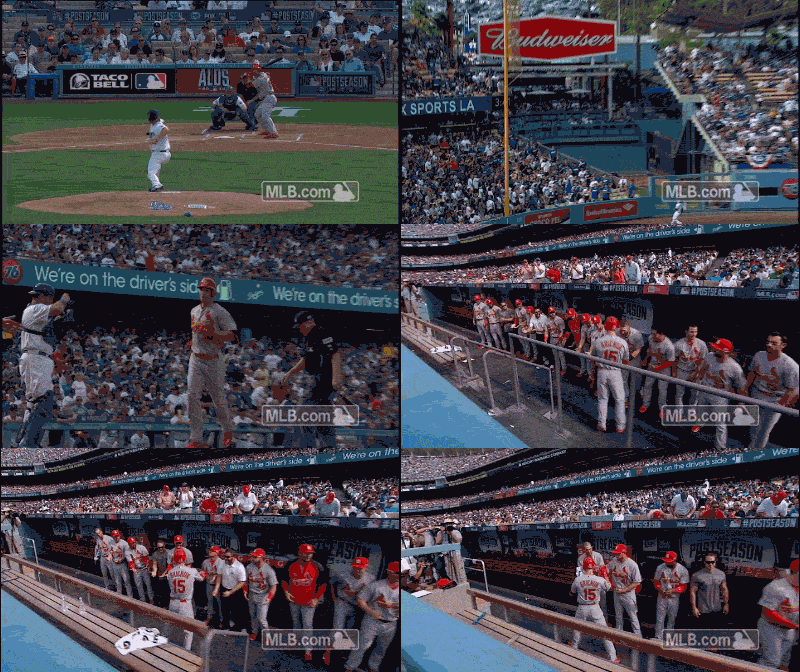
Unfortunately, the timing did not work out as Wacha was only able to make one minor league appearance before the minor league season ended. He was added to the MLB roster on September 4th and made two starts before being skipped in the rotation since it was clear he was not ready to be making MLB starts. He returned to make two more late September starts. All told he made four starts totaling 16.2 innings and allowed 31 baserunners while only striking out 11. He never appeared right and was prone to overthrowing as his average fastball velocity in those starts was above 94 MPH while he typically is 92-93.  The Cardinals insisted he was healthy and could pitch relief in the playoffs, but he wasn't called upon until Game 5 of the NLCS, the BIGGEST MOMENT OF THE SEASON, when this happened:


I'm looking forward to reading about this decision, and many others from both the 2013 and 2014 playoff runs, in Mike Matheny's second Manifesto to be published sometime in 2020. But seriously, the Game 5 showing only added more questions about Wacha's 2015. He should have been shut down when it was clear he would not be able to rehab enough to regain his stuff and he certainly should have been left off the playoff roster. Even with him on the playoff roster, he should not have been thrown in the Game Five situation. He has reported to camp healthy and is throwing bullpens - with a new, sharper curve - and is confident that his shoulder will hold up.

There's no way of knowing if Wainwright's elbow and Wacha's shoulder are actually healthy until they're pitching in Chicago the first week of April. Wainwright has averaged 5 fWAR over the past three seasons and Wacha has accumulated 3 fWAR in only 171.2 career MLB IP. Wainwright has also averaged over seven innings a start in each of the last two seasons which helps keep the bullpen fresh. Even if both are not as effective as they've been in the past, simply staying healthy and combining for close to or above 400 innings is essential for the Cards' success in 2015. If one of them experiences an injury setback, the team will likely need to go outside the organization to find help as the internal options beyond Marco Gonzales are underwhelming.

The current fallbacks beyond Marco, and Jaime, include Carlos Villanueva, Tyler Lyons, and Tim Cooney. John Gast, the starter Wacha initially replaced in 2013, is recovering from an even more severe shoulder injury, only threw 64.1 innings last year, and is not a viable option.

The best case scenario for the team is to use Villanueva as a long-reliever. After not making any starts in 2010, the Blue Jays and Cubs both used him as a starter at times over the last four seasons. The Cards signed him in early February on a minor league contract and it seems likely that he'll break camp with the team. I'll touch more on the bullpen in a future post, but for now, the results show that Villanueva is clearly a better reliever than a starter:


Reliever
Starter

IP
ERA
K/BB
OPS
IP
ERA
K/BB
OPS
2011
33.2
1.60
1.63
.522
73.1
5.15
2.63
.762
2012
33.1
3.24
1.71
.718
92
4.50
3.44
.772
2013
38.2
3.03
3.8
.656
90
4.50
2.17
.755
2014
58
2.64
3.56
.648
19.2
10.53
5
.989
Total
163.2
2.64
2.49
.646
275
5.11
2.82
.789

Lyons and Cooney provide value as cheap, spot starters. If either of them need to take the ball every five days, the season will be in shambles. Cooney is the better prospect of the two - he has ranked on the team's top 10 prospect lists in each of the past two seasons - but he has average stuff and it does not project to translate well to the majors. The best case scenario for him is a back end starter with an extremely small margin for error. He made 25 starts at AAA Memphis last year and had an extreme platoon split. Right-handed batters hit 18 home runs against him and reached base at a .331 clip while left-handed hitters hit .219/.292/.291 with only three home runs. He'll likely provide depth as a left-handed reliever in the bullpen or make a spot start or two.

Tyler Lyons has made 23 appearances, including 12 starts, in MLB over the past two seasons and has actually held his own in the limited exposure. He has thrown 89.2 innings with a 4.62 ERA and 1.22 WHIP. He, too, has a wide platoon split. In his MLB career, left-handed hitters have a .500 OPS while right-handed hitters have a .778 OPS. The split was similar at AAA in 2014 with left-handed hitters hitting .577 OPS compared to .820 OPS for right-handed hitters. The splits also suggest that Lyons should be used as a reliever. In 11 MLB relief appearances, totaling 24 innings, Lyons has allowed 16 hits while striking out 26 and walking only six. That was good for a 1.13 ERA compared to a 5.89 ERA as a starter. His 2014 appearances in Memphis told a similar story as he allowed a 1.023 WHIP as a reliever but it ballooned to 1.38 as a starter.

Behind Marco Gonzales, who is the clear sixth starter, but should pitch in the minors to maximize his potential, there are no good options. Villanueva, Lyons, and Cooney all provide value since they COULD start, if needed, but all three are much more effective in relief roles. Lyons and Cooney in particular are prime trade pieces as I believe they could both pitch effectively out of an MLB bullpen.

Baseball Prospectus' PECTOA projects Wacha and Wainwright to combine for 7 WARP. This is tied for second in MLB of any team's top two starters. Only Zack Greinke and Clayton Kershaw project for more and the Nationals' Stephen Strasburg and Max Scherzer also project for 7. PECOTA projects the Cards' duo to throw 417.1 IP. The Steamer projection system is not as optimistic. The system projects Wainwright to throw 173 IP, his fewest since 2008 when he missed over 70 games with a finger sprain, and be worth 2.5 fWAR. Similarly, Steamer projects Wacha to throw 153 IP and accumulate 1.7 fWAR. Steamer projects the two to throw about 90 fewer innings than PECOTA, which effectively further reduces their values because those 90 innings will have to be eaten by a replacement level starter and increases the burden on the bullpen over the course of the season.

The Steamer projection represents the absolute lower bound of production needed from Wainwright and Wacha for the team to be a strong contender for the division title. Although I have my issues with Steamer, I think tempering expectations for the two is reasonable given the health uncertainty. As both begin to appear in Spring Training games, and ultimately the regular season, it will be easy to tell if they are healthy.

None of the questions I am writing about will have a bigger impact on the Cards' success this season than this question. In my mind, the duo's innings and production go hand in hand. PECOTA projects only six teams to get 400 or more innings from two of their starters and I don't think it's likely Wainwright and Wacha cross that threshold if they aren't producing. If they aren't producing, it likely means they are not healthy, and then the team has major problems.


Wednesday, February 18, 2015

Spring Training Preview, Question 3: Centerfield?

In a series of seven posts, I'll be looking at some early spring issues facing the Cardinals. Today's question covers centerfield.

Barring injury, Jon Jay and Peter Bourjos will again see substantially all of the center field playing time in 2015. The two combined to start 156 of 162 games in 2014 with Jay starting 91 of those. Jay’s 91 starts were his fewest at the position since 2011 and his 468 plate appearances were also his fewest since 2010. On the surface, Jay had a nice season in 2014 as he bounced back from a .276 average in 2013 to hit .303, more in line with his career .295 average. He also improved his CF defense by posting positive UZR and DRS values compared to negatives in both in 2013.

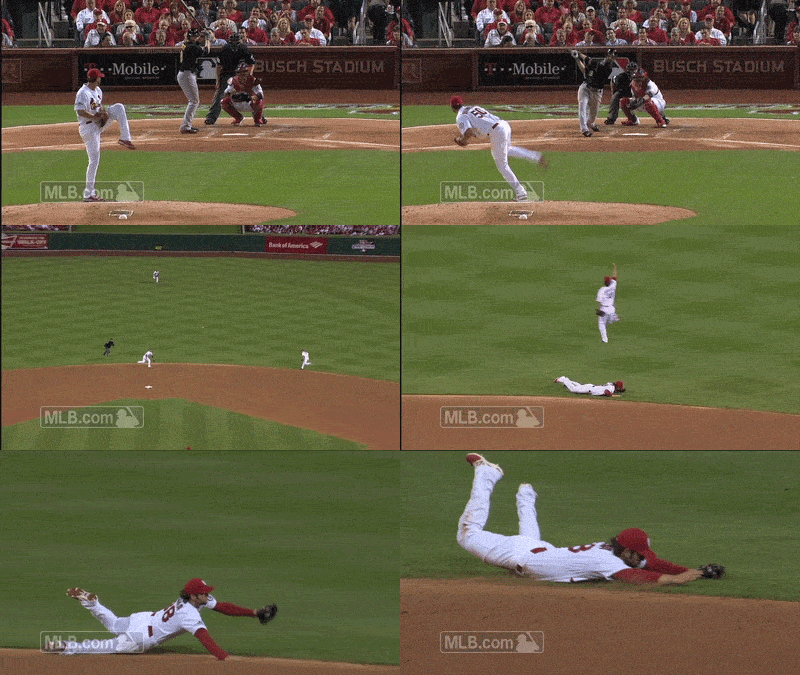
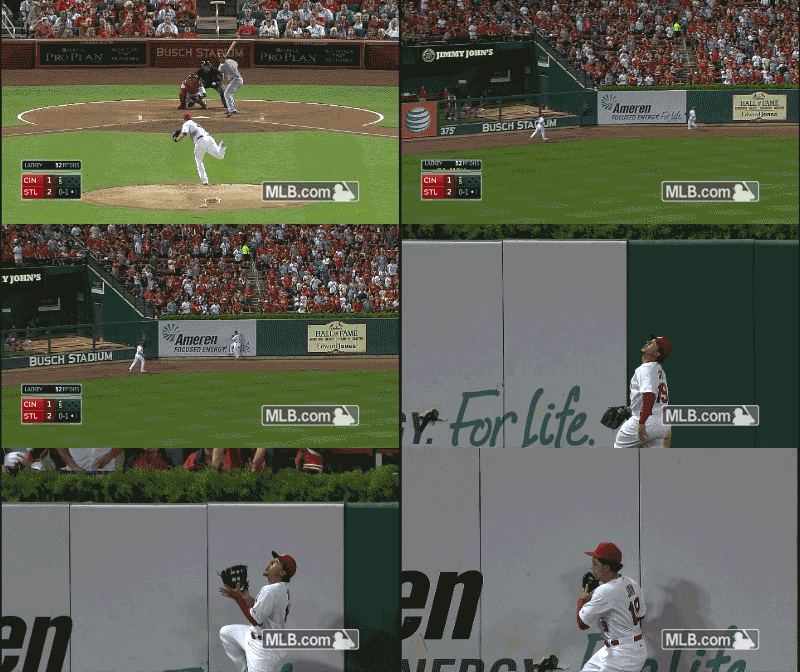
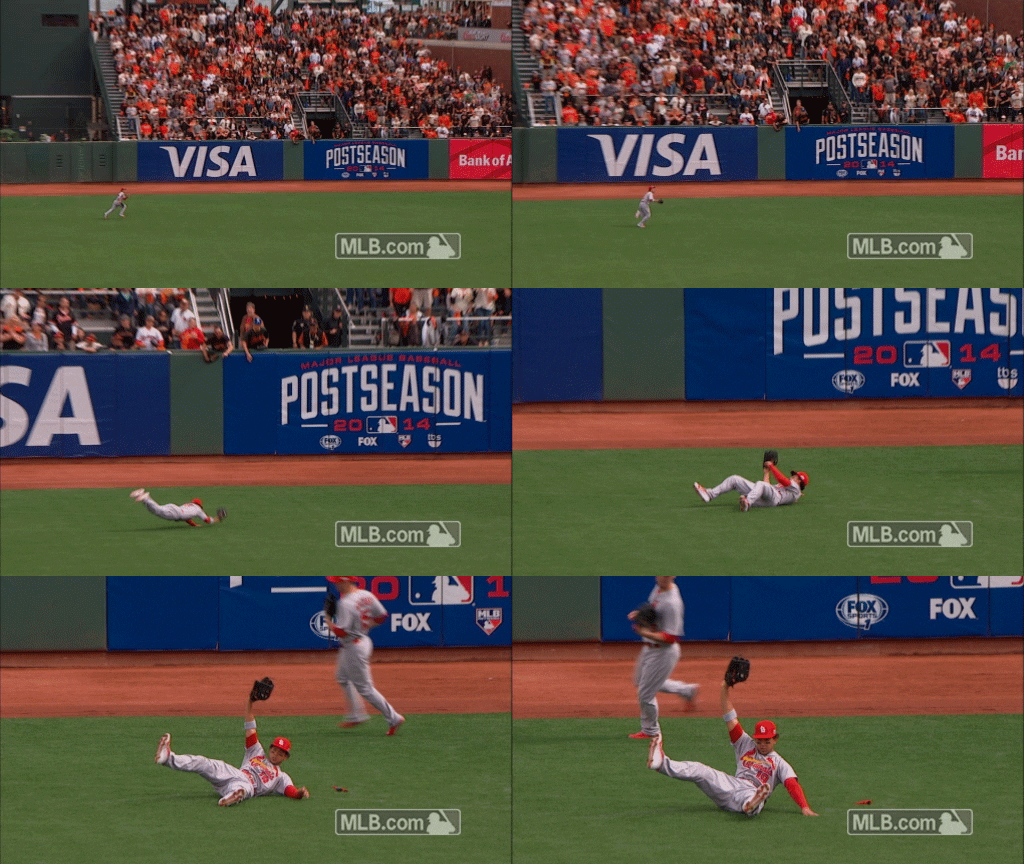
However, there are plenty of reasons to be skeptical about both of these bounce-backs. First, as mentioned above, Jay did not get anywhere near a full season’s worth of playing time. Defensive statistics are more prone to sampling error than offensive statistics and Jay only made 136 plays in CF according to BIZ. BP’s FRAA stat had Jay as a negative for the second year in a row and trending in the wrong direction. The below plays are typical Jay plays. In both he comes very close to missing the ball but manages to make an outstanding play:


Second, Jay did not reach the majors until he was 25. Despite still being under team control for two seasons, he’ll turn 30 in March. He’s getting old and it’s quite possible that he has lost a step or two as shown by a variety of base-running metrics:


On Base
BP BRR
EBT
OOB
BT
SB+CS/SBO
2012
190
-0.5
48%
2
22
12.4%
2013
224
3.6
53%
5
18
6.1%
2014
179
-1.6
49%
9
11
4.5%

Over the past three seasons, Jay has been making more outs on the bases (OOB), taking fewer extra bases (EBT and BT), and running less (SB+CS/SBO). All told his overall base-running contributions were negative last year as compared to the year before, suggesting a player losing speed.

At best he’s an average defender and an average base-runner, but both of those are likely to be negative this season. At the plate he brings an empty average and not much else. He has a very slight platoon split, mostly caused by a .405 SLG vs right-handed pitchers and a .365 SLG vs left-handed pitchers and 25 of his 28 career home runs have come facing right-handed pitching. Overall his 2012-2014 ISO of 0.089 is the 41st lowest of hitters with 600+ PAs over that span. His OBP is boosted by an abnormally high amount of HBP as he has been plunked 49 times over the span, good for second most on that same list of hitters, while on a rate basis he’s the sixth most hitter over the past three seasons. There is some “skill” involved in HBP, but it also adds injury risk and should not be weighted as heavily as other ways a player can reach base in any assessment of a player's value.

The majority of Cardinals fans are too quick to write off Peter Bourjos. On an fWAR/PA basis, he outproduced Jay while bWAR/PA gave a slight advantage to Jay. Bourjos did this while hitting .231/.294/.348 in 294 PAs and only playing 649 innings in the field. In some ways Bourjos is the complete opposite of Jay. He is a very strong defender, a great baserunner, and while his batting line will be less impressive, the drop is not substantial because Bourjos hits for much more power. The knock on Bourjos’ 2014 season was his strikeouts. He struck out 26.5% of the time and that’s not far from his career average. Fans should expect him to continue to strike out and that’s NOT BAD.

Despite substantially fewer opportunities, Bourjos only had three fewer XHB than Jay. That being said, Bourjos is similar to Jay in that he also gets plunked at a high rate, does not hit for much more power, and does not have a platoon split. Bourjos has struggled to stay on the field over his career and his 264 PAs in 2014 were the second most of his five year career while his other three seasons were between 181 and 168. Although 2014 was the first time since 2010 he did not go on the DL, he underwent hip surgery in November and should be at full strength to start camp.

PECOTA projects Jay to hit .279/.343/.381 and Bourjos .246/.303/.385. I think Bourjos has more batting average and on-base upside while Jay’s line is basically what one could expect. At the very least they should see about equal playing time. Jay should never face a left-handed pitcher, unless Bourjos is unavailable, and given Bourjos’ defensive ability, I’d like to see him play the majority of the time vs right-handed pitching. The Cardinals say the job is Jay’s and they gave him a two year extension paying him $6.225 million in 2016, severely limiting his trade value if Bourjos emerges. Bourjos avoided arbitration and signed for $1.65 million and is also under team control through 2016. It seems unlikely both will be on the 2016 roster, but the team should be glad to have both this year. It's hard to imagine Bourjos playing worse than he did in 2014, while Jay is a prime candidate for regression.